
For several years, online marketplaces such as Temu, Shein, Amazon and Wish have posed exacerbated risks to consumers with regards to product safety, harmful chemicals, aggressive marketing, unfair commercial practices, and lack of traceability of traders. Aggressive marketing, including surveillance-based marketing and the use of dark patterns are harmful to consumers who often end up buying more than intended. In summary, the online marketplaces use trading patterns that are harmful to consumers, traders, and the environment.
The marketplaces take advantage of a legal loophole in the EU legislation which entails that the marketplaces aren’t sufficiently responsible of ensuring that the products they facilitate from sellers to the consumer are safe and live up to EU standards before they enter the European market. In addition, they are exempted from Vat and tariffs, and make consumers pay for waste management by acting as free-riders in the systems for extended producer responsibility. These issues need to be addressed and fixed as it causes unfair competition for the European traders as well as an unacceptable risk to European consumers.
Substantial problems with non-compliance from online marketplaces
According to the EU Commission, around 4.6 billion low-value consignments, i.e. goods with a value not exceeding €150, entered the EU market in 2024 – equaling 12 million parcels per day. This is twice as many as in 2023 and three times as many as in 2022 (Safe and sustainable e-commerce imports (2025)).
Tests and investigations of products from online marketplaces show a high degree of non-compliance compared to products from Danish retailers, e.g. high levels of reprotoxic boron in slime, illegal “forever” chemicals, PFAS, in rain jackets, huge amounts of harmful heavy metals in cheap jewelries and endocrine disrupting phthalates in shoes.
Far more and worse exceedances on online marketplaces compared to European retailers
In this test we looked at toy slime from online marketplaces as well as big, Danish retailers as supermarkets and toy stores. The red line shows the EU limit value for boron, a preservative and suspected endocrine disruptor.
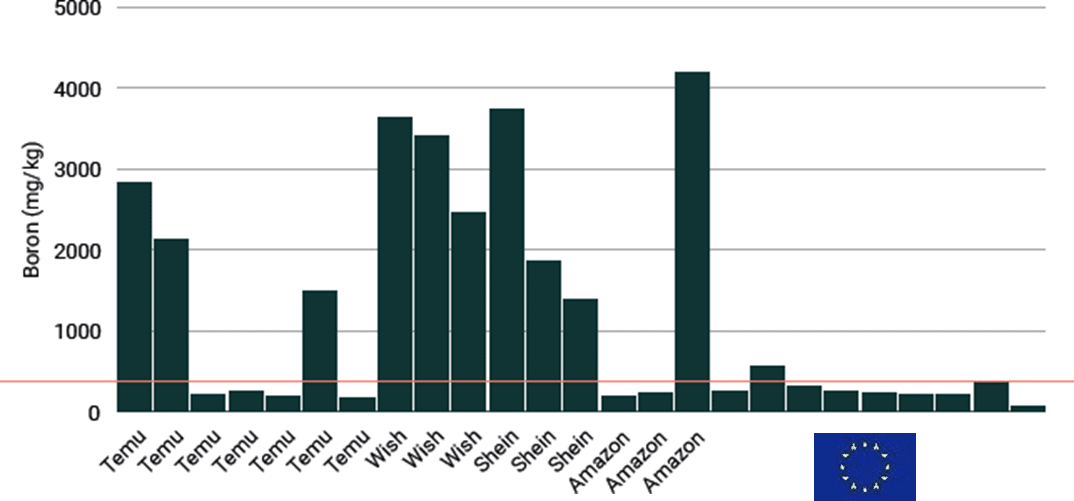
Overall, tests conducted by The Danish Consumer Council from 2019 until now show that 45 pct. of products from online marketplaces contained illegal and hazardous chemicals.
45 percent of all tested products contained illegal substances

The Danish Safety Technology Authority (Sikkerhedsstyrelsen) have checked 100 products from ten online marketplaces. The checks showed that more than 90 percent of the products were illegal or dangerous. It was only possible to find an EU responsible person/EU Representative in 30 percent of the cases, and only half of them were cooperative. It was only possible to identify the local trader in 30 percent of the cases. 80 percent of these traders could not provide the required technical documentation (Sikkerhedsstyrelsen dumper ni ud af ti produkter fra onlinemarkedspladser (2024, Danish)).
The Swedish Chemicals Agency (KEMI) found in a study from 2024 that 62 percent of the products purchased from online marketplaces contained hazardous substances. Among the illegal substances found were lead in electrical products, cadmium in jewelry, and shortchain chlorinated paraffins and phthalates in soft plastic materials.
The Norwegian environmental agency tested 13 children’s products, including toys, jewelries and sandals made of plastics and or metal. They found prohibited substances in 8 of them (Fann farlege miljøgifter i Temu-produkter).
Many other organizations have found similar results in their tests of products from online marketplaces, e.g. Toy Industries of Europe who found that 80 pct. of toy products from online marketplaces failed EU standards and could be a danger to children (80% of toys bought from third-party traders on online marketplaces fail EU safety standards and could be a danger to children – Toy Industries of Europe).
DSA does not solve the problem
The Digital Services Act (DSA) deals with classic consumer legislation, e.g. rules on advertising, misleading of consumers etc. in relation to online marketplaces, but it fails to deal with the issue of distribution and supply of products from 3rd countries to European consumers through online marketplaces.
Rules on advertising and misleading of consumers relate to commercial communication which is a sort of immaterial content in the same category as other immaterial content such as text, audio-visual or visual content. The content itself do not directly cause physical harm to either the consumers or the environment.
The fundamental principle in the DSA is that the platforms, including online marketplaces, covered by the DSA have a shield against liability and a right to invoke a “no obligation to monitor”. This “no obligation to monitor” that the platforms (including the online marketplaces) have been granted, runs diametral contra to the obligation of importers and other economic operators to ensure the compliance of products from 3rd countries before the products are sold on the EU market.
Solutions
The online marketplaces that facilitate products from sellers in 3rd countries must have the same proactive responsibilities as importers for ensuring that the products or packaging comply with EU law before products or packaging are put up for sale in the EU. They need to be defined as ‘economic operator’.
This can best be achieved through adaptation of EU legislation in line with one of these two models:
1. DSA-model:
The adoption of a new section or targeted amendment in the Digital Services Act that introduces proactive obligations for online marketplaces regarding the sale of products from sellers and factories in 3rd countries to EU consumers.
2. Omnibus-model:
An omnibus regulation defining obligations of online marketplaces that facilitate the sale of products from sellers or factories in 3rd countries making their obligations similar to importers’ obligations. (An omnibus regulation is a regulation that changes many regulations or directives at once. The omnibus regulation should cover all product safety and environmental legislation).
Yhteiskannanotossa mukana olivat Forbrugerrådet Tænk, Forbrukerrådet, Sveriges Konsumenter ja Kuluttajaliitto ry.